Everyone must be tired of hearing about the ghoulish tourism vehicle turned billionaire crushing machine, but I think I make a couple of points which you may not have heard yet, and might be worth listening to ― whether it be about the sociology of wealth, or the ASME Boiler Code. Also I use a little simple arithmetic to explore assumptions about energy policy. And there are some intriguing fillers at the end.
Tag: a step farther out
ASFO 2023–06–17
The “Juneteenth” holiday, and the recent death of disgruntled mathematician Ted Kaczynski, bring me back to the question of the as–yet unfinished work of emancipation, which somehow requires me to cast aspersions on the literary works of Herman Melville and James Joyce. Regardless of that, however, I consider the Marxist idea of historical inevitability, and the doctrines of economics as taught in the business schools, as modern equivalents to the old idea that the existing order of society is the direct manifestation of the Will of God, and it is not only impious but futile to imagine that it could be any other way. This I regard as extraordinarily dangerous and destructive, because we humans are at this time more masters of our own destiny than has ever been true in the past.
- Archive Recording
- 2023 ASFO Masterpost
- A Step Farther Out Masterpost
- Previous Week
- Following Week
- Patreon campaign
Supplementary Shows
- 2023–06–20 I commence reading the South Sea Bubble chapter of Extraordinary Popular Delusions and the Madness of Crowds.
- 2023–06–23 Conclusion of the South Sea Bubble, and my reflection on its relevance to current affairs. Probably all I will read from this book. Also, at the beginning, one brief extract from Science–Fiction : The Early Years by Bleiler.
ASFO 2023–06–10
Unclean! unclean! or, a neat way to circumvent that nasty habit of ratiocination some humans have. Also, dams and other concrete structures ; the damnable American workplace ; and the dark suspicion that Wall Street Journal articles are being written by “AI”. Dorlisa Flur, really? (The lack of a show last week was entirely owing to my error.)
- Archive Recording
- 2023 ASFO Masterpost
- A Step Farther Out Masterpost
- Previous Week
- Following Week
- Patreon campaign
Supplementary Shows
- 2023–06–13 Continuation of “John Law and the Mississippi Bubble”.
- 2023–06–16 Conclusion of the “Mississippi Bubble” chapter of Extraordinary Popular Delusions and the Madness of Crowds, and sundry announcements, about some records I have bought to provide interstitial material for HNtW, and about Pemmi–Con and my planned exhibits there.
ASFO 2023–05–27
Hamlet ― yes, the Shakespeare play ― a mathematical concept called the “zero ring”, violence at Target stores, and a long filibuster in the Nebraska legislature… what do these things possibly have in common? Maybe nothing! But they all serve to illustrate one of my major concerns : the intersection of lack of knowledge with lack of understanding. We live today in an enormously complex society, and there is such a wealth of information available that no human mind can deal with it all. As a result, people who specialize in one subject are often totally divorced, both in knowledge and in working methods, from those who specialize in another. Meanwhile, our societies give evidence of being caught in vast eddies and backwashes of ignorance.
- Archive Recording
- 2023 ASFO Masterpost
- A Step Farther Out Masterpost
- Previous Week
- Following Week
- Patreon campaign
Supplementary Show
- 2023–05–30 “Every patient represents an improbable event.” Conclusion of Vignette №20, Populations, Samples, and Items, and commencement of №21, Probability is not Gambling.
- 2023–06–02 “Small sample statistics of ambiguously defined events in ambiguously defined populations are almoset certain to be the most colossal lies perpetrated. But large sample estaimates made from precisely defined events happening to closely regulated items can be more accurate measurements of what actually happened than is achievable in any other science.” Completion of Vignette №21, Probability is not Gambling, and all of №23, What is a Good Small Sample? (Unfortunately I don’t seem to have №22.) Then I talk about various things for a few minutes, including the Chernobyl tragedy of 1986.
- 2023–06–06 Vignette №24, A Tracer Has No Pharmacology, concluding the first volume (really binder) of Vignettes in Nuclear Medicine by Marshall Brucer, MD. The material most interesting to the general public is mainly in this first volume, so I will probably stop here, absent requests to continue. Also a great deal of commentary and discussion from me.
- 2023–06–09 A piece in the Wall Street Journal leads me to read from that monumental work of supercilious Victorian moralizing, Memoirs of Extraordinary Popular Delusions and the Madness of Crowds. I start at the beginning (of the 1841 edition, which is somewhat different in content and arrangement than the 1852 edition) with John Law.
ASFO 2023–05–20
Zeppelin the Musical, and the pathetically inadequate transit arrangements in the vicinity of Füssen (seriously, tourist towns in the USA often do better) caused me to be late in starting, and so that’s what I mostly talk about. I don’t attempt to review the show, but I do talk about the technical aspects, which made excellent use of the extensive facilities of the Festspielhaus. This playhouse, apparently constructed to stage a show about King Ludwig II of Bavaria, faces his world–famous creation, the architectual oddity known as Schloss Neuschwanstein, across a modest–sized lake.
- Archive Recording
- 2023 ASFO Masterpost
- A Step Farther Out Masterpost
- Previous Week
- Following Week
- Patreon campaign
Supplementary Show
2023–05–26 Because my previous reading of Vignette №19, The Maximum Ridiculous Dose, did not archive, I start over from the beginning. Then I get partway into №20, Populations, Samples, and Items ― an introduction to statistics, from the clinical standpoint.
ASFO 2023–05–13
How would you even start to regulate tens of millions of household–sized battery packs, if they pose a significant fire and explosion hazard? I make a rough estimate that it would occupy, full–time, about 10% of the electricians in the United States. Also updates on the apparently open–ended emergency in Germany, and some more of my wondering why people should be less interested in addressing the real problems than in making up imaginary ones to get excited over. Not the most coherent of episodes.
- Archive Recording
- 2023 ASFO Masterpost
- A Step Farther Out Masterpost
- Previous Week
- Following Week
- Patreon campaign
Supplementary Shows
- 2023–05–16 An abbreviated show, because I stayed at a museum until closing time. I finish up Vignette №17, What Can Happen to an Electron? (The Interaction of Radiation with Matter, Part III). Then I use the remaining time to read part of a press release from the Norwegian University of Science and Technology, reporting a study on the land area occupied by various energy sources, which uncharacteristically takes the form of an impassioned plea for nuclear energy as a way to preserve biodiversity while addressing climate change.
- 2023–05–19 More from the always informative and usually entertaining Brucer. All of Vignette №18, How Radiation Affects Tissue (The Interaction of Radiation with Matter, Part IV), in which Bertrand Russel appears as an aside, and we learn of the “most commonly repeated statement in the whole history of medicine” ; then a goodly chunk of Vignette №19, The Maximum Ridiculous Dose, exploring the tortured history of radiation measurement and its interaction with the Law. (Unfortunately cut off short, before the end of №18, by some kind of technical problem.)
ASFO 2023–05–06
Did I wait in a line for two hours to spend ten minutes in a sewer? Does the world know all too well, and still regret, what happens when Germany enters an open–ended state of emergency? Is there a role for monarchies in a world of democratic ideals? All this, and an actual historical example of something I have repeatedly derided, known as “V2H”. As a bonus, I tell you about a simple one–page Web site I irritated someone into creating.
- Archive Recording
- 2023 ASFO Masterpost
- A Step Farther Out Masterpost
- Previous Week
- Following Week
- Patreon campaign
Supplementary Shows
- 2023–05–09 Vignettes in Nuclear Medicine by Marshall Brucer, MD, continues to supply grist for the mill. From last time, the conclusion of Vignette №14, The Radium Bomb : How it Exploded Into (And Out Of) Nuclear Medicine, and the beginning of №15, What Can Happen to a Gamma Ray?, the first of four under the general head of The Interaction of Radiation with Matter.
- 2023–05–12 Continuing onward through The Interaction of Radiation with Matter, №16, The Attenuation of Gamma Radiation, and a goodly chunk of №17, What Can Happen to a Beta Particle?
ASFO 2023–04–29
Space is hard. Everyone admits that. But, for goodness sake, if you will pay close attention to the mistakes people before you have made, you can avoid doing the same stupid thing! This post brought to you by watching someone lose a game of Lunar Lander at the Vintage Computer Festival Europe, when the recent private Japanese lander Hokuto–R appears to have been lost in the exact same way.
- Archive Recording
- 2023 ASFO Masterpost
- A Step Farther Out Masterpost
- Previous Week
- Following Week
- Patreon campaign
Supplementary Shows
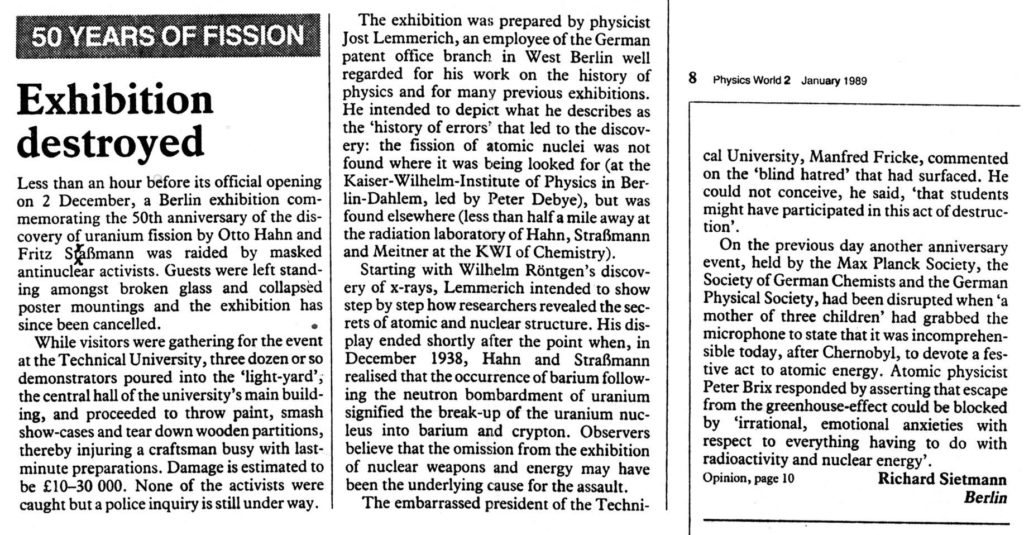
- 2023–05–02 More from Vignettes in Nuclear Medicine by Marshall Brucer, MD : completion of №11 from last time ; №12, The True History of Atomic Energy Revealed, which is quite the piece of storytelling ; and the beginning of №13, $ How Much $ ? — with a break between 12 and 13 to read Nuclear Power is Green Power, an editorial by John Gittus of the United Kingdom Atomic Energy Authority, printed in Physics World for January 1989. A mention of this piece in a clipping read in a recent ASFO show led me to inquire of the publishers, the Institute of Physics, who kindly supplied it.
- 2023–05–05 Completion of Vignette №13, $ How Much $ ?, and all but the very tail end of №14, The Radium Bomb : How it Exploded Into (And Out Of) Nuclear Medicine. How do I manage that so consistently?
ASFO 2023–04–22
While some people are celebrating “Earth Day”, I prefer to wait until 20 July and celebrate “Get Me Off This Earth Day”. Also, observations on German rural life and Kleingartenanlagen (allotment gardens), and some new thoughts about the “Theatre of the Atom”.
- Archive Recording
- 2023 ASFO Masterpost
- A Step Farther Out Masterpost
- Previous Week
- Following Week
- Patreon campaign
Supplementary Shows
- 2023–04–25 More from Vignettes in Nuclear Medicine by Marshall Brucer, MD. End of №7, Lowell Erf and the New Cure for Leukaemia (Phosphorus–32), carried over from last time ; №8, The *T3 Test (TBI and Other Procedures) ; and the first part of №9, The Sex Life of the Screw Worm Fly, The Taxonomy of Medical Radioisotope Scanning.
- 2023–04–28 Conclusion of Vignette №9 ; №10, Sixty–Five Years of Medical Radioisotope Scanning (Which is Clinically Really Only About Five Years Old) ; and the first part of №11, The Rea$on for Radioi$otope$ in Medi¢ine.
ASFO 2023–04–15
The sleep of reason (it has been said) brings forth monsters. Whether that is the shutting down of nuclear power in Germany, or of public lending libraries in the United States of America, it is clear that those monsters are loose in our world. To oppose and overcome them requires being intellectually awake and alive.
- Archive Recording
- 2023 ASFO Masterpost
- A Step Farther Out Masterpost
- Previous Week
- Following Week
- Patreon campaign
Supplementary Shows
- 2023–04–18 Continuing Vignettes in Nuclear Medicine by Marshall Brucer, MD. №5, The Modes of Radioisotope Decay, An Explanation of a Language, which is quite difficult to read aloud owing to the extensive use of diagrams ; and a good bit of №6, The Modes of Radioisotope Decay, How Many Isotopes Are There?
- 2023–04–21 Beginning with the “scientist’s prayer” from the novel Arrowsmith by Sinclair Lewis, I finish Vignette №6, and almost all of №7, Lowell Erf and the New Cure for Leukaemia. As I so often do, I had to stop one paragraph short of the end.